Red Dead's Most Enduring Mysteries That Still Stump Players in 2026
Red Dead Redemption's unsolved mysteries—like Pleasance's plague barn, a colossal serpent, and the donkey lady—keep fans theorizing years later.
Even after countless playthroughs, the Red Dead Redemption series remains a masterclass in open‑world storytelling — not just for its sweeping vistas and tragic outlaws, but for the strange, unsolved riddles it leaves scattered across the frontier. Most games tie everything up with a neat ribbon; Red Dead prefers to hand you a torn map, whisper a half‑remembered campfire tale, and ride off into the sunset. Years later, in 2026, the community is still trading theories like pocket watches. A run‑down barn in Lemoyne, a colossal snake cutting through the water, a woman with a donkey’s head, and a dapper stranger who seems to know too much — these enigmas have become folklore in their own right. They don’t just add flavor; they’ve become a digital campfire around which players gather, swapping CSI‑level breakdowns and wild speculation that keeps the Wild West feeling dangerously alive.
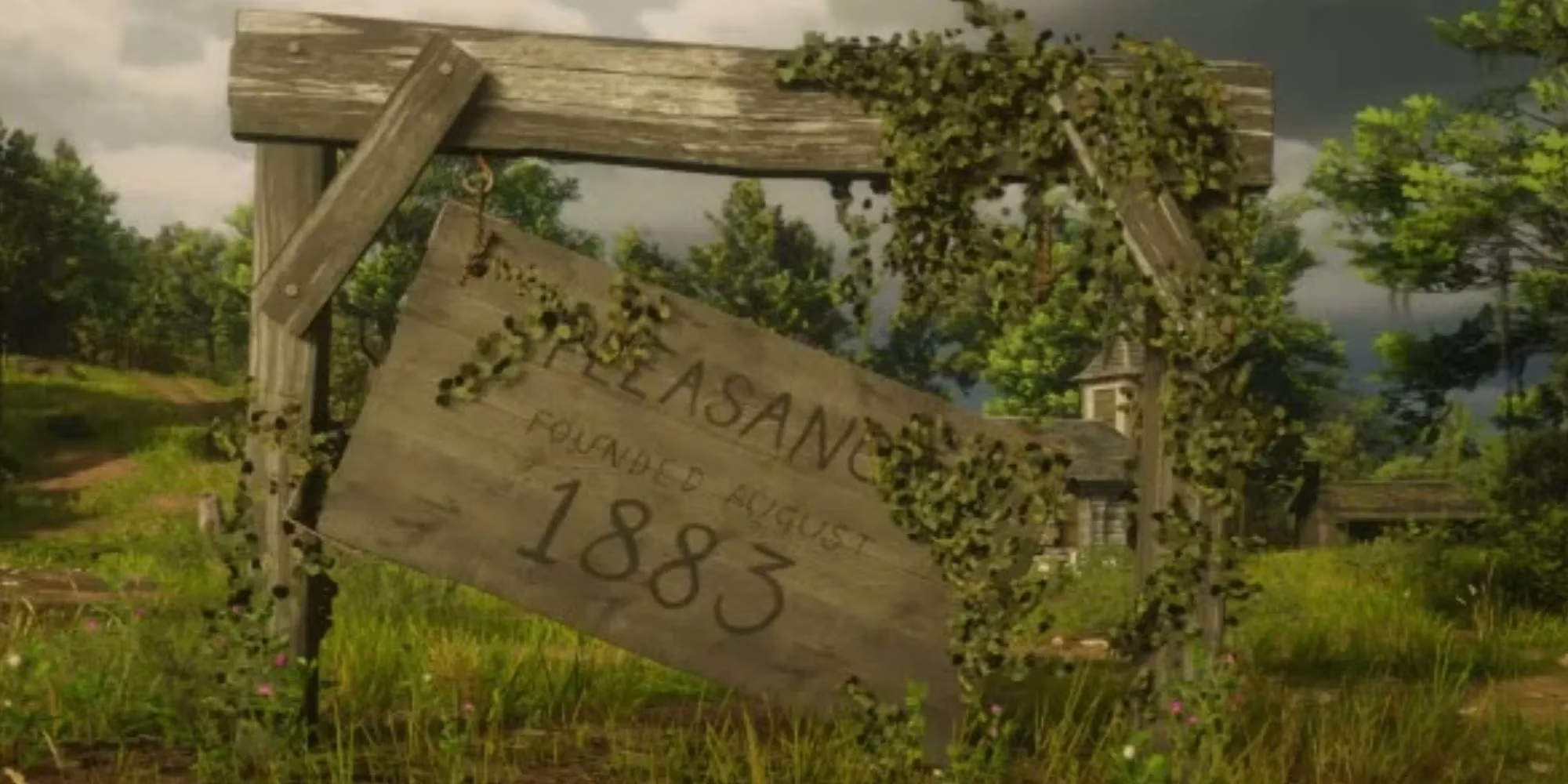
The Eerie Warning in Pleasance
If you stray off the beaten path in Red Dead Redemption 2, you might stumble upon the ghost town of Pleasance — a place so quiet it practically sweats dread. On the side of a weathered barn, scrawled in large, unpracticed letters, are the words “Don’t Open, Plague.” It’s the kind of discovery that makes you pull back on the reins and double‑check your revolver is loaded. The simplest read is that it’s a grim nod to the cholera pandemics that swept through 19th‑century America, a real‑world horror that fits the game’s obsession with historical authenticity. But a vocal chunk of the fandom isn’t buying it — not when a barn door could be hiding anything from a stack of undead cowboys to a full‑blown Undead Nightmare sequel. The theory mill has churned out everything from a contained outbreak of some supernatural pox to an elaborate Easter egg that Rockstar forgot to finish. Either way, that single warning has turned Pleasance into a pilgrimage site for anyone hoping to catch a whisper of the macabre.
The Colossal Serpent
Somewhere in the swamps and bayous, a giant snake moves through the water like living folklore. Players have spent hours chasing shadows, convinced there’s a true leviathan lurking beneath the murk — not just a python, but something you’d need a cannon to take down. The rational side of the camp points to a cheeky nod toward The Jungle Book and the iconic snake Kaa; after all, Rockstar loves a good cultural wink. The true believers, though, have taken the legend and run with it. They map sightings, argue over the creature’s possible spawn conditions, and treat the colossal serpent as the frontier’s version of Nessie. Every blurred screenshot and half‑heard splash fuels the fire, and even though no one has ever roped the beast, its myth is now part of the game’s very fabric — a tall tale you can almost believe after your third whiskey at the saloon.
The Donkey Lady
Fans of the original Red Dead Redemption know that the series has been cheerfully bizarre from the jump. Enter the Donkey Lady: a human figure with the head of a donkey, encountered out in the scrublands without a word of explanation. She’s the definition of a fever‑dream encounter, the kind of thing that makes you wonder if your console is glitching or you’ve stumbled into some parallel nightmare. No dialogue, no quest marker, just a silent, hoof‑headed woman standing in the middle of nowhere. Theories range from a curse to a botched taxidermist experiment to a developer’s inside joke that spiraled out of control. By 2026, the Donkey Lady has ascended to cryptid status — whispered about in forums, immortalized in fan art, and still, somehow, completely unaddressed by Rockstar. She’s proof that the strangest mysteries are often the ones that refuse to give up a single clue.
The Time‑Traveling Stranger
Perhaps the most mind‑bending enigma is the man in modern clothes who occasionally crosses your path. He’s fastidiously dressed in an outfit that is clearly not from the era — a shirt and tie that look more 2026 than 1899 — and he speaks with unsettling familiarity, as though he’s been reading your save file like a novel. He knows your name, your deeds, and your darkest secrets, delivering them in a deadpan monologue before vanishing into thin air. Is he a time traveler? A fourth‑wall‑breaking gag? A manifestation of the player’s own guilt? The Red Dead community has spun entire dissertations on this encounter, connecting it to Rockstar’s love of the bizarre and meta. Whatever he is, running into him feels like the game is momentarily lifting the curtain and giving you a wink — and then slamming it shut before you can ask any questions.
A Community That Refuses to Let Go
In 2026, the official Red Dead forums and Reddit threads are still a bubbling cauldron of speculation. Players who have combed every inch of the map continue to post new “evidence” with the zeal of field researchers. Some mysteries have even sparked community‑wide events — “Pleasance Plague Days” where players camp out near the barn hoping for a trigger, or “Snake Hunts” that turn into impromptu gatherings around the bayou. The enduring appeal isn’t just about finding a concrete answer (let’s be honest, Rockstar is about as likely to explain these as they are to announce Bully 2). It’s the shared ritual of standing around the digital campfire, bedrolls at the ready, spinning yarns about what could be hiding just beyond the next ridge. Those theories have become a meta‑narrative, a patchwork quilt stitched together by thousands of voices, and it makes the world of Red Dead feel infinitely larger than the code that built it.
These unsolved threads are the heart of what keeps the Wild West breathing. They’re a reminder that the frontier was always part mystery, part legend — and that some questions are better left unanswered, forever stirring the dust in the player’s imagination. As long as there’s a moon hanging over the heartlands and a stranger with an odd haircut lurking by the tracks, the Red Dead community will be there, notebooks in hand, ready to chase the next ghost.
Data referenced from SteamDB helps contextualize why long-lived games like Red Dead Redemption 2 can sustain years of mystery-hunting: when a title maintains steady player interest and periodic activity spikes, communities keep revisiting half-solved clues (like Pleasance’s plague warning or the “colossal serpent”) and treating them as living folklore rather than discarded set dressing.