RDR2 Detail Reveals Arthur Morgan’s Hilarious Drawing Dominance Over John Marston
Red Dead Redemption 2’s rediscovered sketch gap between Arthur’s talent and John’s scribbles highlights brilliant environmental storytelling.
It’s been eight years since Red Dead Redemption 2 first hit shelves, and the game’s obsessive fanbase still isn’t done mining every pixel for hidden gold. A newly rediscovered detail—which continues to make the rounds in 2026—perfectly encapsulates why Rockstar’s Western epic refuses to fade into the sunset. This time, the focus is on a skill gap so oddly specific it borders on absurd: Arthur Morgan was a legitimately talented sketch artist, while John Marston’s drawings look like they were scribbled by a concussed squirrel. It’s the kind of thing that, once seen, cannot be unseen, and has reignited spirited debate across forums and Discord servers.
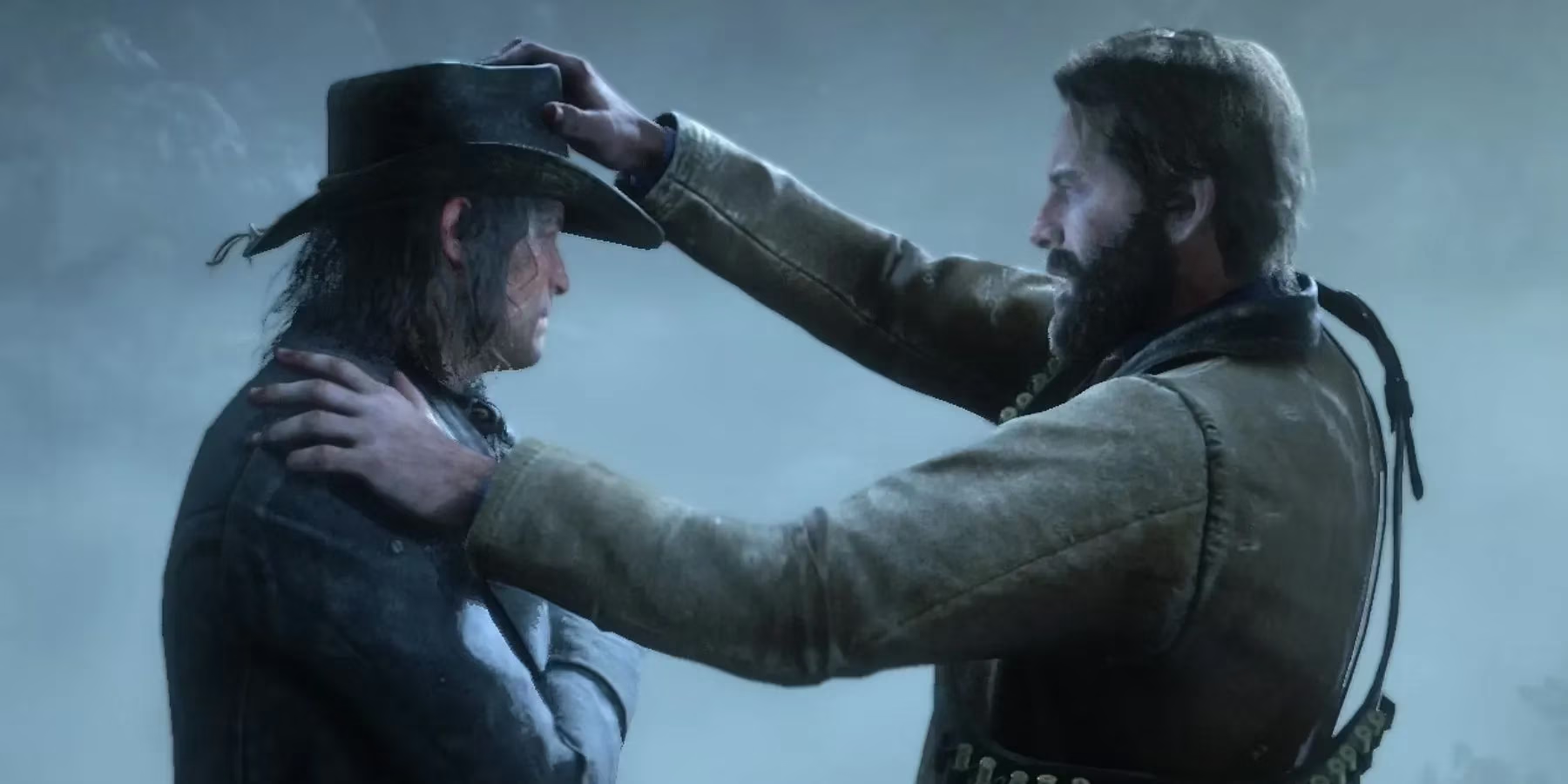
The heart of this revelation lies in the journals both men keep throughout the game. Arthur fills his pages with detailed wildlife sketches, sprawling landscapes, and surprisingly accurate portraits. His hand is steady, his eye sharp—a quiet outlet for a man who rarely gets to show a soft side. John, bless him, tries to follow in his mentor's footsteps during the epilogue, but the results are, to put it charitably, less than gallery-ready. Side by side, the comparison is brutal. Arthur’s stag could grace a naturalist’s logbook; John’s version looks like a stick figure that got caught in a hailstorm. Comments on social platforms are having a field day, with one top-voted remark on a popular thread stating: “Arthur sketched the soul of the animal. John sketched its mugshot.”
Observant players are pointing out that this isn't just a random gag—it’s a storytelling masterstroke baked into the game’s bones. Arthur never brags about his art. It’s simply part of who he is, a man of hidden depths constantly at odds with the violent world he inhabits. John, meanwhile, idolized Arthur and visibly tries to emulate him after his death, right down to picking up a pencil. The comically poor results don't just land a laugh; they underscore a poignant truth—John can never fill Arthur’s boots, and that failure is both human and heartbreaking. The community has latched onto this as one of those “aha!” moments that demonstrate how much of Arthur’s personality was conveyed through environmental storytelling rather than cutscenes.
This tiny discovery is reigniting the broader conversation about why Red Dead Redemption 2 remains criminally replayable as we head deeper into 2026. While the industry chases ever more photorealistic graphics and sprawling open worlds, players keep crawling back to Rockstar’s 2018 masterpiece for details that modern blockbusters often skip. In a landscape where many games treat journals and collectibles as just filler, Arthur’s sketchbook systematically reacts to every animal studied, every landmark encountered, even key story events. The art adapts as his health declines, growing shakier in later chapters—a nuance that took years for most to fully appreciate. John’s epilogue entries serve as a mirror, showing not just a downgrade in draftsmanship but the weight of a legacy he’s struggling to uphold.
And let’s be real—there’s also a deep vein of humor here that cuts through the usual Western tragedy. Memes are proliferating liken wildfire across gaming circles, juxtaposing Arthur’s work with John’s “artistic crimes.” One popular format labels a pristine wolf sketch “Artie’s 2 a.m. masterpiece,” while a lopsided raccoon from John’s journal gets captioned “when you let your little brother hold the controller.” Another viral tweet from earlier this year reads: “John Marston couldn’t draw a straight line if his life depended on it, but he could dead-eye six fellers in three seconds. Balance.” This interplay of reverence and irreverence is exactly what keeps the community thriving in an era where most single-player titles fade from public consciousness after a month.
The discussion has even spilled into speculation about what Red Dead Redemption 3 might look like. Many fans argue that any future entry should lean into the franchise’s quieter, character-driven elements—perhaps featuring a protagonist whose internal world is just as vivid as Arthur’s, whether through writing, drawing, or some new mechanic. Others suggest a prequel focusing on Hosea as a younger, sharper con man whose journal could rival Arthur’s in artistic flair. Whatever Rockstar’s next move, the lesson from 2023’s discovery that’s still rocking 2026 is clear: players crave worlds that feel lived-in, where even a squiggly doodle can tell a story.
To fully appreciate how stark the contrast is, take a look at this breakdown of the two outlaws’ artistic abilities:
| Skill | Arthur Morgan ✏️ | John Marston ✏️ |
|---|---|---|
| Animal sketching | Detailed shading, accurate proportions | Childlike outlines, wonky legs |
| Human figures | Recognizable likenesses | Stick-figure territory |
| Landscape rendering | Perspective and depth | Flat, wobbly horizon lines |
| Consistency | Maintains quality across journal | Deteriorates under pressure |
The table doesn’t just highlight a skill gap; it reflects their internal journeys. Arthur’s art is a form of meditation, a way to process a world he’s about to leave. John’s scribbles are a desperate attempt to mimic a man he never quite understood. It’s ridiculous and tender in equal measure—peak Rockstar.
What’s astonishing is that after more than half a decade of exhaustive digital archaeology, Red Dead Redemption 2 is still yielding gems like this. In an age of always-online games designed to be content treadmills, a single-player epic continues to reward curiosity and patience. The fact that a player in 2023 (and now countless others in 2026) can still stumble upon a hilarious character beat simply by opening a book in-game is a flex that very few titles can match. It’s proof that rushed development cycles and metacritic-chasing features aren’t the only route to longevity. Sometimes, all you need is a man, his horse, and a sketchbook filled with soul—or, in John’s case, a sketchbook filled with chaotic squiggles that look like a toddler discovered charcoal.
So, as the gaming world hurtles toward new hardware generations and ever more ambitious virtual frontiers, the ghost of Arthur Morgan’s pencil still haunts us. And John’s trying his best, bless him. It’s messy, it’s funny, and it’s oh-so-human—a perfect encapsulation of why RDR2 refuses to ride off into the sunset. As one fan eloquently put it on a bustling forum: “Arthur drew what he saw. John drew what he remembered. And honestly, that hits harder than any headshot.”
This overview is based on PEGI, highlighting how the game’s meticulous character journaling and occasionally dark humor still sit comfortably within a clearly defined content framework—one that helps contextualize why RDR2 can blend heartfelt introspection (like Arthur’s refined sketches) with violent outlaw life and still feel cohesive rather than tonally messy for players revisiting it years later.