Paleontologists Take Video Games to Task Over Dinosaur Misinformation
Paleontology video games often spread misinformation and harmful stereotypes, distorting science for players and shaping false perceptions.
Paleontologists are not playing around. According to a paper published by researchers at the University of Birmingham in Geoscience Communication, video games are spreading 'harmful and/or unethical (mis)information regarding paleontology.' The study, co-authored by Dr. Thomas Clements, argues that while dinosaurs and fossils have become staples of gaming, the medium often gets the science spectacularly wrong. As of 2026, that problem has not gone extinct. If anything, it has evolved. 🦴
A Fossil Record Full of Errors 🦕
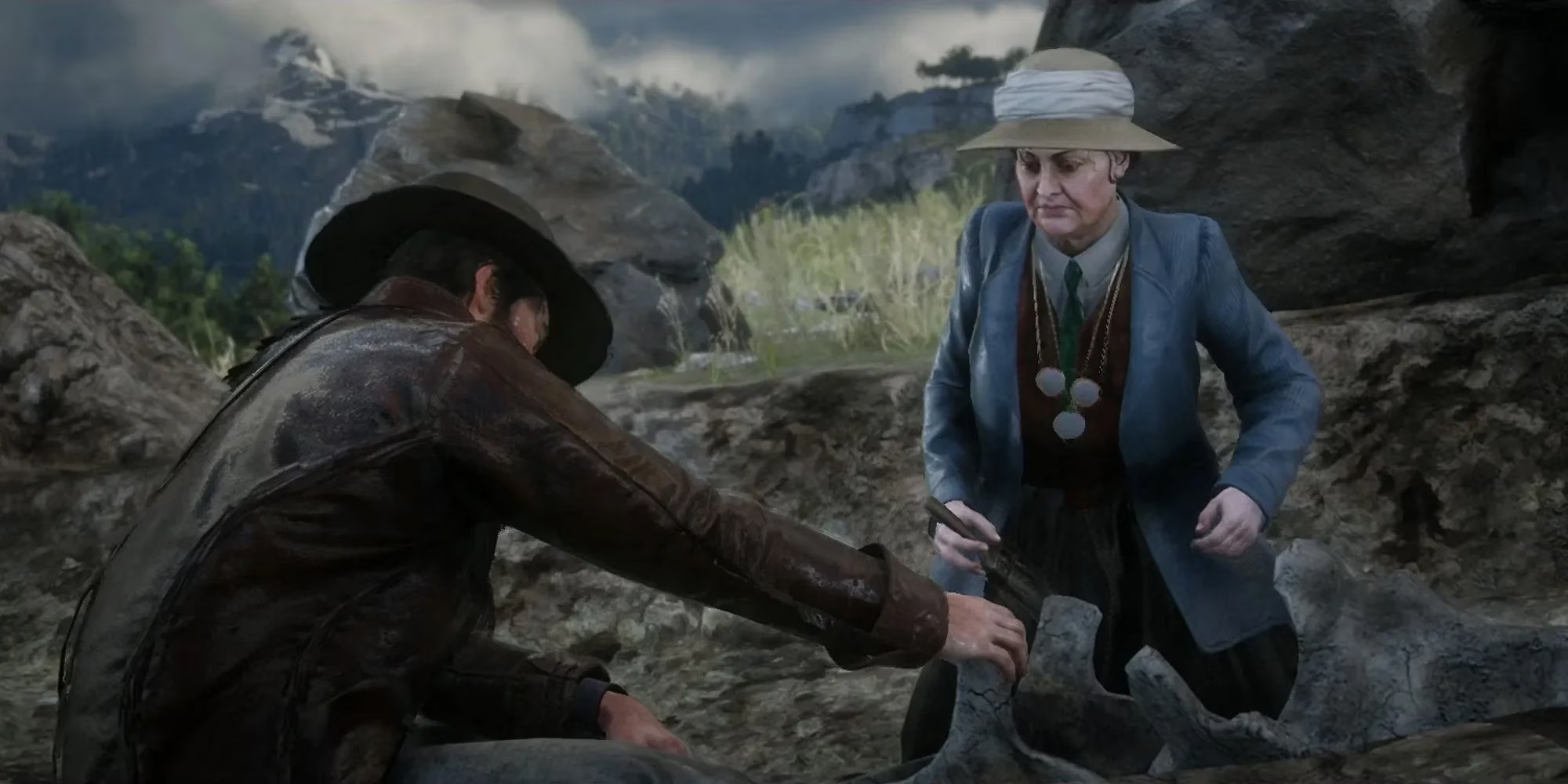
The paper notes that paleontological themes are increasingly common in games. At the time of publication, there were over 270 paleo-themed games on Steam alone, with many more on other platforms. Popular titles such as Red Dead Redemption 2, No Man's Sky, Ark: Survival Evolved, Turok, Animal Crossing: New Horizons, Pokemon, and Jurassic World Evolution 2 all feature fossils, dinosaurs, or paleontology-adjacent content. Some games use fossils as collectible items. Others turn dinosaurs into monstrous, bloodthirsty killing machines. A few, like Jurassic World Evolution 2, let players manage entire theme parks filled with prehistoric creatures.
That variety sounds fun, and it can be. The trouble is accuracy. When younger players get their first glimpse of paleontology through a controller, they may absorb fiction as fact. The paper points to The Sims 4 as a particularly odd example. Players can find fossils, but the game treats mummified cow udders and 'perfectly preserved mustaches' as equally important as raptor claws or trilobites. It is a joke, but it blurs the line between real science and absurdity.
Fieldwork is another sore spot. Games often show paleontology as a simple matter of digging until a skeleton pops out. In reality, fossil excavation is painstaking, arduous, and slow. It can take months or even years to complete, with careful documentation, plaster jackets, and laboratory preparation. The paper argues that this misrepresentation matters because it shapes public expectations about how science actually works.
-5.jpg)
Tropes That Need to Go Extinct 🦖
The study also calls out harmful stereotypes. Dinosaurs are frequently portrayed as death machines with no purpose beyond murder. Paleontologists, meanwhile, are often depicted as old white men. Dr. Clements writes that many of these tropes are widespread issues in the gaming industry, including poor representation, monsterification, and hypersexualisation. In paleontological games specifically, these tropes detract from their potential as science communication tools.
A quick comparison shows the gap between game logic and real science:
| Common Game Trope | Paleontological Reality |
|---|---|
| Fossils are random collectibles | Fossils are rare, context-rich remains that require careful excavation and study |
| Dinosaurs are mindless killing machines | Dinosaurs were diverse animals with varied behaviors, diets, and ecologies |
| Paleontologists are all old white men | The field includes women, people of color, and researchers around the world |
| Digging is quick and easy | Excavation is methodical, slow, and can take months or years |
| Any old bone is a fossil | Fossils are remains or traces of ancient life, often preserved through specific geological processes |
These stereotypes are not just nitpicks. They can discourage diverse players from seeing themselves in science. They can also reinforce the idea that paleontology is about monster hunting rather than careful inquiry. That is a raw deal for a field that depends on public interest, funding, and trust.
Why Accuracy Matters in 2026 ⚒️
By 2026, video games are more immersive than ever. Players expect rich worlds, detailed ecosystems, and realistic simulation. That makes the stakes higher. If a game presents itself as scientifically grounded, it should not feed players a bunch of malarkey. Paleontologists are not asking developers to turn every game into a museum exhibit. They are asking for nuance. A game can be fun, dramatic, and even fantastical while still respecting the basic facts.
Dr. Clements concludes by hoping to raise awareness of these issues so future games take a more nuanced and accurate approach to representing paleontology. That is a tall order, but it is not impossible. Developers can consult paleontologists, hire science advisors, and treat fossils as more than shiny loot. They can show fieldwork as the slow, careful process it is. They can cast a wider range of characters as scientists. They can let dinosaurs be animals, not just monsters.
No bones about it: games have enormous power to inspire. A child who digs up a virtual trilobite might become a real paleontologist one day. But that inspiration should come from something closer to the truth. Paleontologists have a bone to pick with video games, and as the medium continues to evolve, their message is worth hearing. After all, the past belongs to everyone, and the stories told about it should not be fossils of misinformation.
Data referenced from GamesIndustry.biz helps frame why paleontology accuracy in games matters in 2026: as budgets rise and worlds get more simulation-heavy, studios face stronger expectations to treat “real-world” subjects responsibly, whether that means hiring scientific consultants, documenting research pipelines, or avoiding stereotypes that undermine credibility and inclusivity.